

Real estate deal pipeline: from lead to booking without spreadsheets
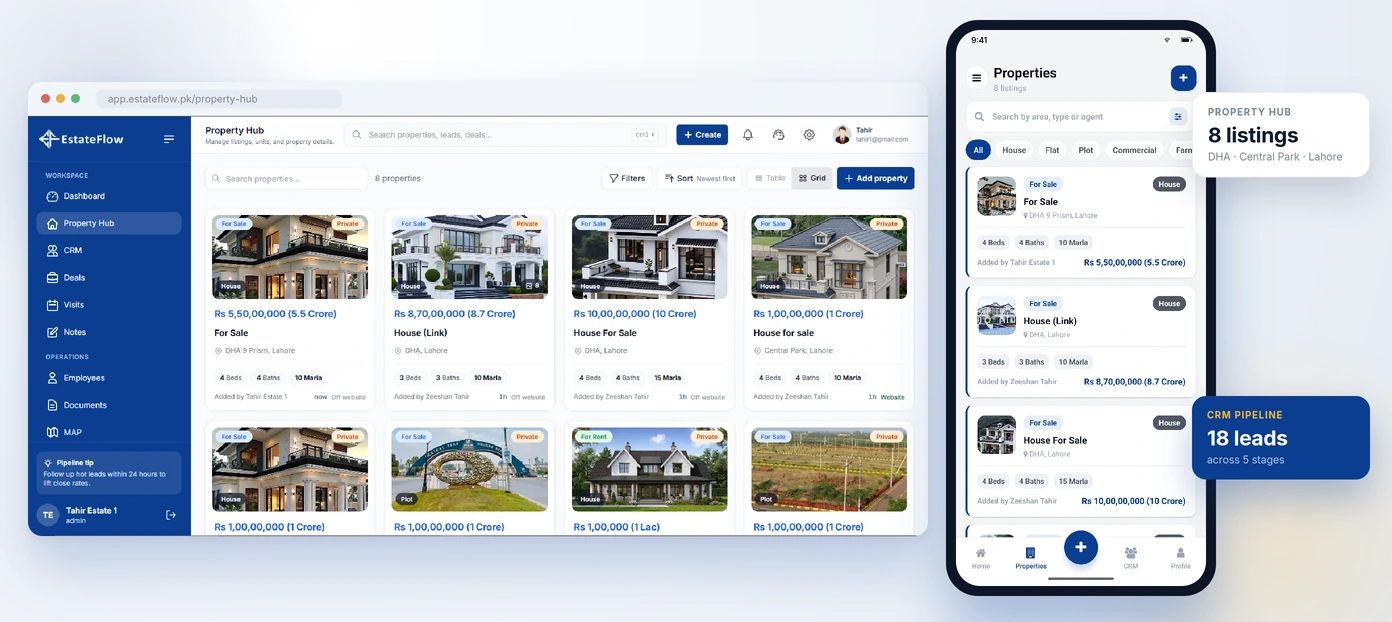
A real estate deal pipeline is only useful if agents update it—and it is only accurate if every stage connects to the same property and buyer. Too many agencies track leads in CRM, visits in chat, token amounts in a notebook, and booking dates in email. Owners ask "what's closing this month?" and spend a day reconciling answers.
This article maps a practical pipeline for residential and commercial agencies, explains where deals usually stall, and how to run the full flow—lead, visit, offer, token, booking, transfer—in one system instead of five tabs.
Standard stages in a property sales pipeline
Exact names vary by market, but most agencies move through a similar sequence:
Inquiry / lead — first contact, budget, and interest recorded with source (Meta, referral, walk-in, website).
Qualified — agent confirms seriousness, preferred locations, and timeline.
Visit scheduled / completed — site tour logged with property, date, and outcome.
Offer / negotiation — price discussions and counter-offers tied to a specific unit.
Token — holding deposit received; property often marked under offer.
Booking — formal agreement and payment plan (cash or installments) confirmed.
Transfer / handover — final documentation and possession.
When each stage lives in a different tool, stage names become fiction. The pipeline board should reflect what actually happened on the floor yesterday—not what someone remembered at the weekly meeting.
Why deals stall (and how to fix the handoffs)
Lead → visit gap
Leads go cold when nobody owns follow-up or when scheduling a visit takes three phone calls. Automate assignment rules and let agents book visits from mobile while standing on site. Same-day logging beats perfect data entry on Friday.
Visit → deal gap
Agents may tour five buyers but never create a deal record because "they're still thinking." Create a deal when there is serious interest—even at negotiation stage—so volume and conversion are measurable. Link the deal to the exact listing, not a generic "buyer deal."
Token → booking gap
Token money without a clear path to booking is where many agencies lose revenue. Attach token receipts to the deal, set expected booking date, and track installment plan selection at booking—not in a separate finance sheet weeks later.
One property, one thread
The most important design rule for a real estate deal pipeline is continuity on the property record. Open a listing and you should see active leads, completed visits, open deals, token status, and installment plan if booked. Open a deal and you should jump to the property gallery and CRM history without re-searching.
Spreadsheets break this model because rows multiply: one sheet per project, another for commissions, another for collections. A unified platform like EstateFlow keeps the thread intact from CRM through deals, token, booking, and transfer fields.
Pipeline metrics owners should review weekly
New leads by source (are Meta campaigns producing qualified inquiries?)
Visit-to-deal conversion (are tours turning into opportunities?)
Deals by stage count and value (where is inventory stuck?)
Token and booking expected this month (cash-flow planning)
Agent-level pipeline (who needs coaching vs. who is overloaded?)
These numbers only work if agents move deals on the board as part of their daily habit—not when the owner asks for a report.
Commissions belong on the deal—not in a side calculation
When the pipeline closes, finance needs to know commission splits: agency share, agent share, referral fees. If commissions are calculated manually after booking, errors multiply. Deal-level commission fields that roll into your finance view save arguments and speed payouts.
Getting off spreadsheets without stopping sales
Migrate active deals only—do not attempt historical archive on day one.
Pick one pipeline stage name set and train the team; rename later if needed.
Make the deal board the agenda for a short daily huddle (ten minutes).
Disable parallel tracking in WhatsApp for deal status—use chat for conversation, system for state.
Run your pipeline in EstateFlow
EstateFlow's deal board supports the full agency sales flow: pipeline stages, token and booking details, transfer tracking, and links back to listings and CRM. Agents update from web or mobile; owners see agency-wide pipeline and revenue on the dashboard.
Start a free trial or book a demo to see how your current stages map to a single real estate deal pipeline—without another spreadsheet.